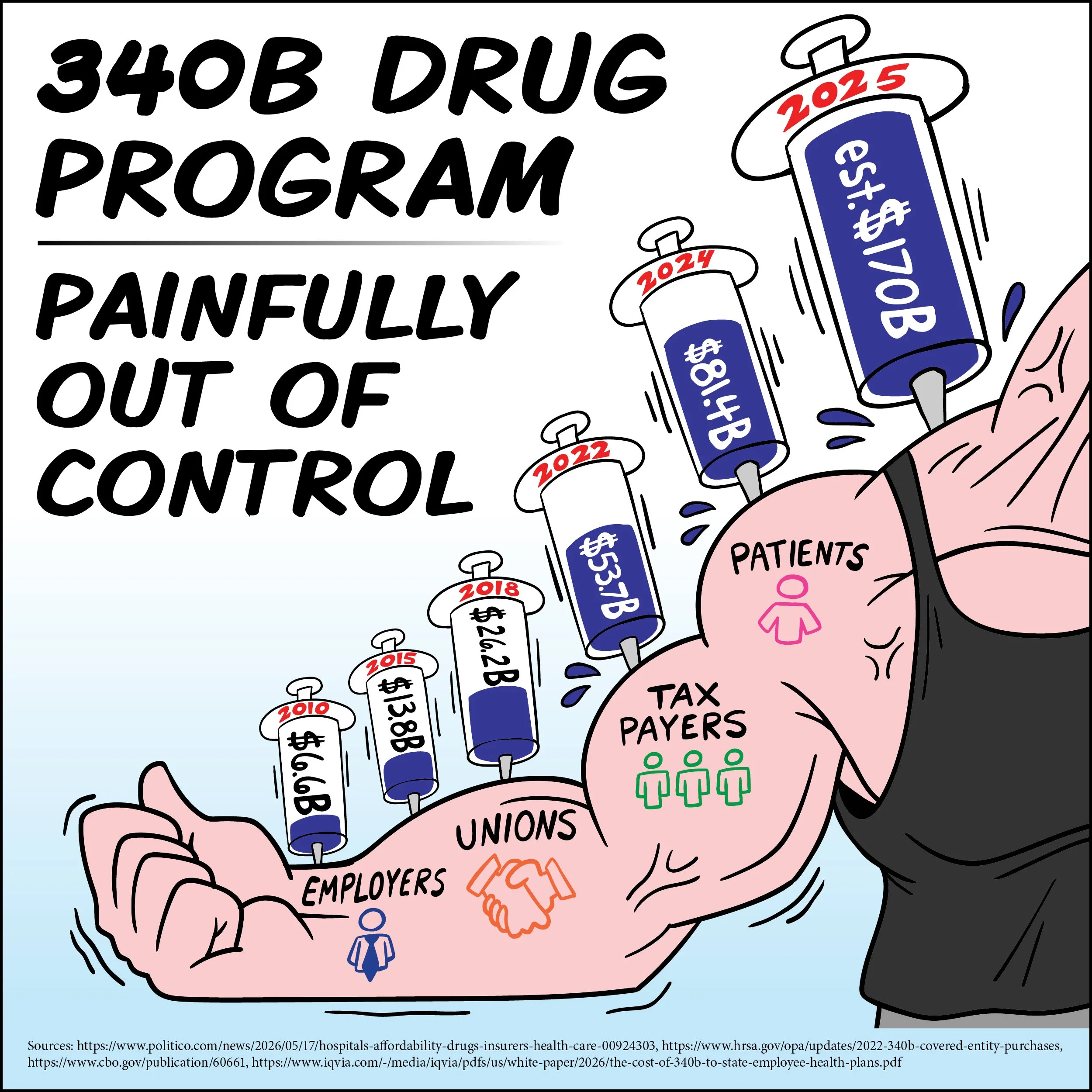
New TAPP Cartoon Illustrates: 340B Drug Program Is Painfully Out of Control
What began as a well-intentioned effort to help vulnerable patients afford medicines has morphed into one of the fastest growing and least transparent programs in American healthcare, and the Trade Alliance to Promote Prosperity has created a new cartoon to illustrate the problem.
The federal 340B Drug Pricing Program was created in 1992 with a simple mission: allow certain safety-net hospitals and clinics to purchase medicines at steep discounts so they could stretch scarce resources and better serve low-income and uninsured patients. Few would dispute that goal.
The problem is that today’s 340B program bears little resemblance to what Congress originally envisioned.
The numbers tell the story.
In 2010, the cost of the 340B program totaled approximately $6.6 billion. By 2015, that figure had more than doubled to $13.8 billion. It reached $26.2 billion in 2018, ballooned to $53.7 billion in 2022, surged to $81.4 billion in 2024, and is estimated to have exceeded an astonishing $170 billion in 2025.
That is not normal growth. That is an explosion.
At a time when policymakers are scrutinizing every corner of the healthcare system for waste, fraud, and abuse, the unchecked expansion of 340B deserves far greater attention.
The original purpose of the program was to help hospitals and clinics serve vulnerable populations. Yet there is no federal requirement that hospitals pass 340B discounts to patients at the pharmacy counter. A hospital can purchase a drug at a deeply discounted 340B price and then charge insurers—or even uninsured patients—the full market rate, keeping the difference as revenue. This spread has transformed what was intended as a patient-assistance program into a major profit center for large health systems and pharmacy chains.
The rapid expansion of contract pharmacies has accelerated the problem. In 1995, covered entities generally worked with a single contract pharmacy. Following regulatory changes, the number of contract pharmacy arrangements exploded, reaching more than 32,000 nationwide by 2024. The more contract pharmacies a hospital controls, the more opportunities it has to generate revenue from discounted drugs.
Even more troubling is the lack of transparency.
Hospitals are not generally required to disclose publicly how much revenue they generate through 340B transactions, how much is retained as profit, or how much is actually used to reduce patient costs. Reform advocates have repeatedly called for reporting requirements that would allow taxpayers and policymakers to determine whether the program’s benefits are reaching the patients whom Congress intended to help.
Consequently, questions persist regarding contract pharmacy arrangements, duplicate discounts, eligibility requirements, and broader program accountability.
To be clear, the answer is not to eliminate the 340B program. Safety-net providers play an essential role in caring for vulnerable populations, and many rely on program resources to support important services.
But a program that has grown from $6.6 billion to an estimated $170 billion in just fifteen years cannot continue operating without meaningful accountability.
Congress should require complete transparency regarding 340B revenues and expenditures, ensure that discounts are passed directly to eligible patients, strengthen oversight of contract pharmacy arrangements, and establish clear reporting standards demonstrating how savings improve patient care.
The 340B program was designed to help patients—not enrich hospital systems, pharmacy chains, and middlemen.
Without reform, it will continue growing at a breathtaking pace while drifting ever farther from its original mission.
A program intended to serve vulnerable Americans has become painfully out of control. It’s time for Congress to fix it.