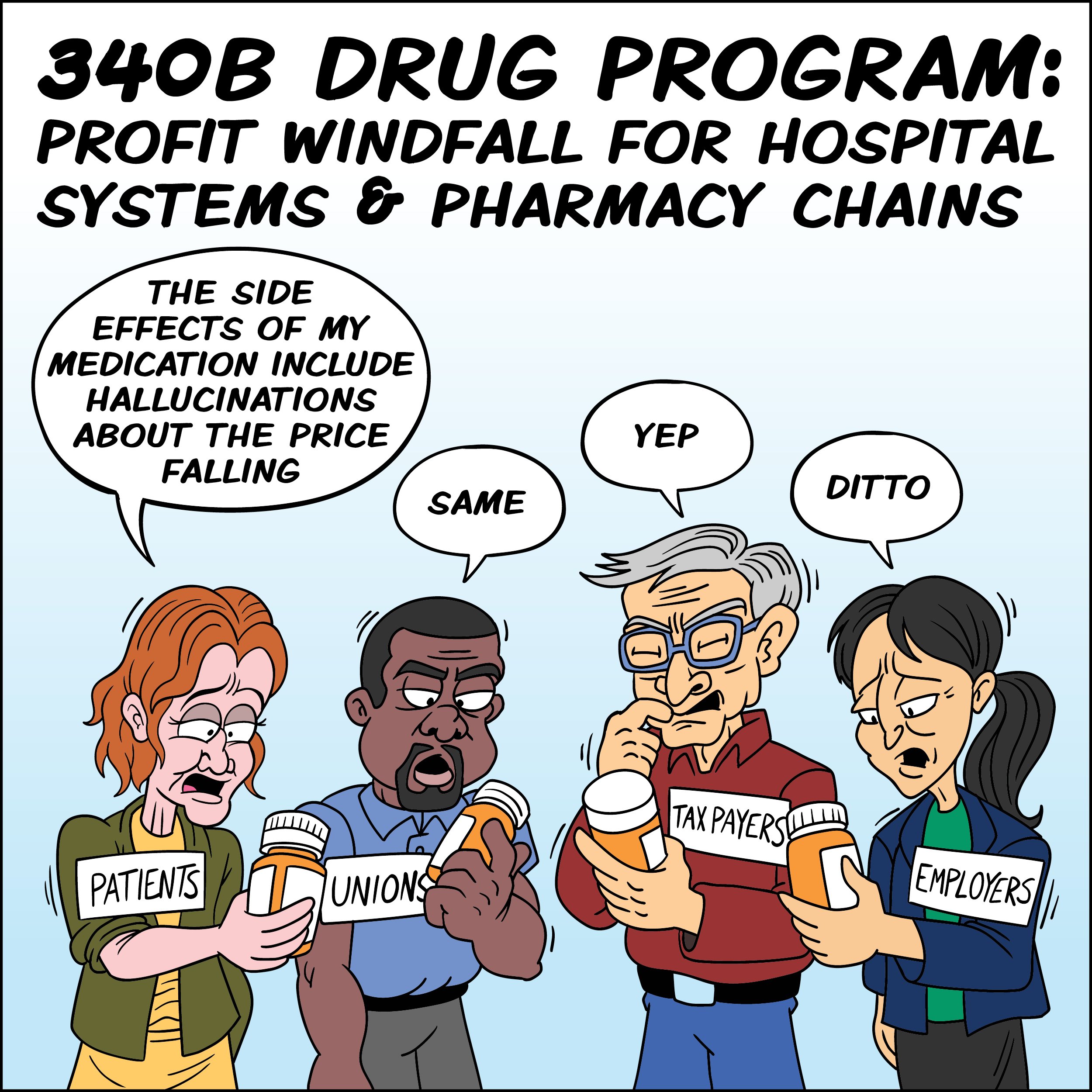
New TAPP Cartoon: Where Do 340B Prescription Drug Discounts Go? Not to Patients!
The federal 340B drug pricing program was created with a simple and admirable goal: help vulnerable and low-income patients access discounted medications. But that’s not how the program has played out. The Trade Alliance to Promote Prosperity has produced a cartoon to illustrate this sad truth.
Congress designed the 340B program in 1992 to allow certain hospitals and clinics serving needy populations to purchase drugs at steep discounts, with the expectation that savings would be passed along to patients in the form of more affordable care.
Instead, the 340B program has increasingly become a massive profit center for large hospital systems and pharmacy chains. Hospitals can purchase drugs at deeply discounted 340B prices while charging insurers—and often patients—full price for those same medications. The difference between the discounted acquisition cost and the reimbursement amount becomes profit for the hospital or its contract pharmacy partners.
The incentives have become so distorted that some large health systems aggressively acquire physician practices and expand into affluent communities simply to increase the number of prescriptions eligible for 340B discounts. Meanwhile, there is little transparency or accountability requiring hospitals to demonstrate that patients are directly benefiting from the program’s savings.
Major pharmacy chains also profit handsomely through contract pharmacy arrangements that allow hospitals to extend 340B pricing through thousands of retail locations nationwide. The result is a sprawling system where middlemen and corporate healthcare entities often benefit more than the vulnerable patients Congress intended to help.
Reform does not mean eliminating assistance for safety-net providers. It means restoring integrity, transparency, and accountability to ensure discounted drugs actually lower costs and improve care for patients in need.
Patients should be the primary beneficiaries of 340B—not pharmacy chains’ and hospital systems’ corporate fat cats.