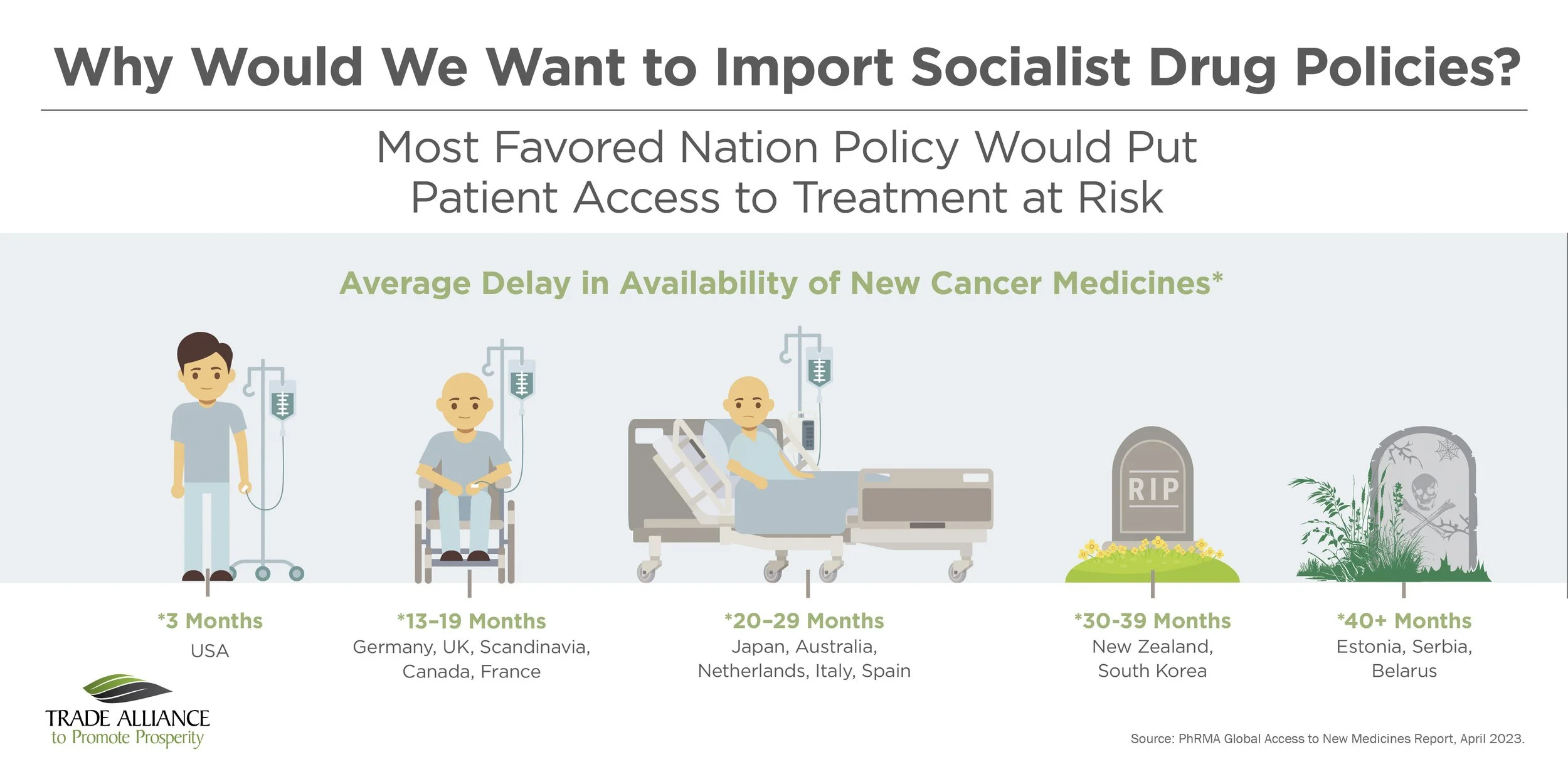
TAPP Disappointed with CMS Finalization of GLOBE Model
The Trade Alliance to Promote Prosperity is disappointed that the Centers for Medicare & Medicaid Services (CMS) has published the final rule on the Global Benchmark for Efficient Drug Pricing (GLOBE) Model despite concerns raised by TAPP and other stakeholders about importing foreign drug pricing policies (“Most Favored Nation”) into the U.S. healthcare system.
Earlier this year, TAPP submitted comments urging CMS to withdraw the proposed GLOBE Model, warning that tying Medicare Part B drug costs to prices in foreign countries could undermine American medical innovation, distort incentives for investment in new treatments, and allow foreign governments’ pricing decisions to influence U.S. healthcare policy.
CMS finalized the model on September 30, 2026. The final rule establishes GLOBE as a mandatory Medicare payment model under the authority of the Center for Medicare and Medicaid Innovation (CMMI).
The model will begin January 1, 2027, with an initial period for manufacturers voluntarily to submit international net pricing data. Its five-year performance period will run from April 1, 2027, through March 31, 2032, with payment and reconciliation activities continuing beyond that date.
Under GLOBE, CMS will change the way Medicare Part B drug inflation rebate amounts are calculated for certain high-spending physician-administered drugs and biological products. The agency will use international drug pricing information to establish benchmarks based on prices in as many as 19 economically comparable foreign countries—this remains our fundamental concern with the policy.
American patients deserve lower healthcare costs, but the United States should not achieve that goal by importing socialist pricing signals from countries that rely heavily on government intervention to determine what they will pay for innovative medicines.
Instead, policymakers should confront the underlying international imbalance: Foreign governments should pay a fairer share of the cost of pharmaceutical innovation rather than allowing American patients and taxpayers to shoulder a disproportionate burden.
The final rule does include several changes from CMS’s original proposal. Among other things, CMS excluded orphan-only drugs, plasma-derived products, and certain cell and gene therapies. Biosimilars and their reference biological products will also be excluded once a biosimilar enters the U.S. market. That’s good.
Still, these changes do not alter GLOBE’s fundamental reliance on international reference pricing.
CMS itself acknowledges the concerns we have raised about discouraging innovation. In the final rule, the agency summarizes comments warning that linking U.S. reimbursement to foreign prices could reduce incentives for research and development, harm patient access to innovative treatments, threaten American jobs, and weaken U.S. global leadership in biopharmaceutical innovation. Yet, somehow, CMS disagrees that the model will have those effects.
There is another important reason to question whether these risks are justified: CMS substantially reduced its projected savings from the model.
When GLOBE was proposed, CMS estimated approximately $8.4 billion in Original Medicare Part B savings over the model period before accounting for changes in Part B premiums. Under the final rule, CMS now estimates only $298 million in Original Medicare Part B benefit savings and $111 million in combined cost-sharing and premium savings for Original Medicare beneficiaries.
The agency estimates just $50 million in direct beneficiary cost-sharing savings over the duration of the model, plus approximately $61 million in premium savings.
Those dramatically lower estimates strengthen the case for pursuing drug-cost reforms that rely on competition, transparency, domestic innovation, and stronger international trade policies rather than foreign reference pricing.
The United States leads the world in developing new medicines because our system has historically rewarded risk-taking, investment, research, and intellectual property. Policymakers should be extremely cautious about adopting policies that allow decisions made by foreign governments to become benchmarks for the American healthcare system.
At TAPP, we continue to believe there is a better approach: Rather than importing foreign pricing policies into Medicare, the administration should use America’s considerable economic and trade leverage to demand that wealthy trading partners contribute more fairly to the cost of developing innovative medicines. At the same time, policymakers should pursue domestic reforms that increase competition, improve transparency, eliminate market distortions, and ensure that savings actually reach patients.
The bottom line: America should export its commitment to innovation—not import foreign price controls.