TAPP Urges Congressional Oversight of COINS Act Regulations
The Trade Alliance to Promote Prosperity today wrote to members of the U.S. Congress to urge them to ask the Department of the Treasury to narrow the biotechnology provisions in its proposed rule implementing the Comprehensive Outbound Investment National Security (COINS) Act.
TAPP Executive Director Kent Kaiser, Ph.D., wrote:
On behalf of the Trade Alliance to Promote Prosperity (TAPP), I am writing to urge you to ask the U.S. Department of the Treasury to narrow the biotechnology provisions in its proposed rule implementing the Comprehensive Outbound Investment National Security (COINS) Act. Congress enacted the law to prevent U.S. capital and expertise from advancing capabilities that threaten our national security. Treasury can carry out that mandate while preserving legitimate commercial partnerships that help American companies develop new medicines.
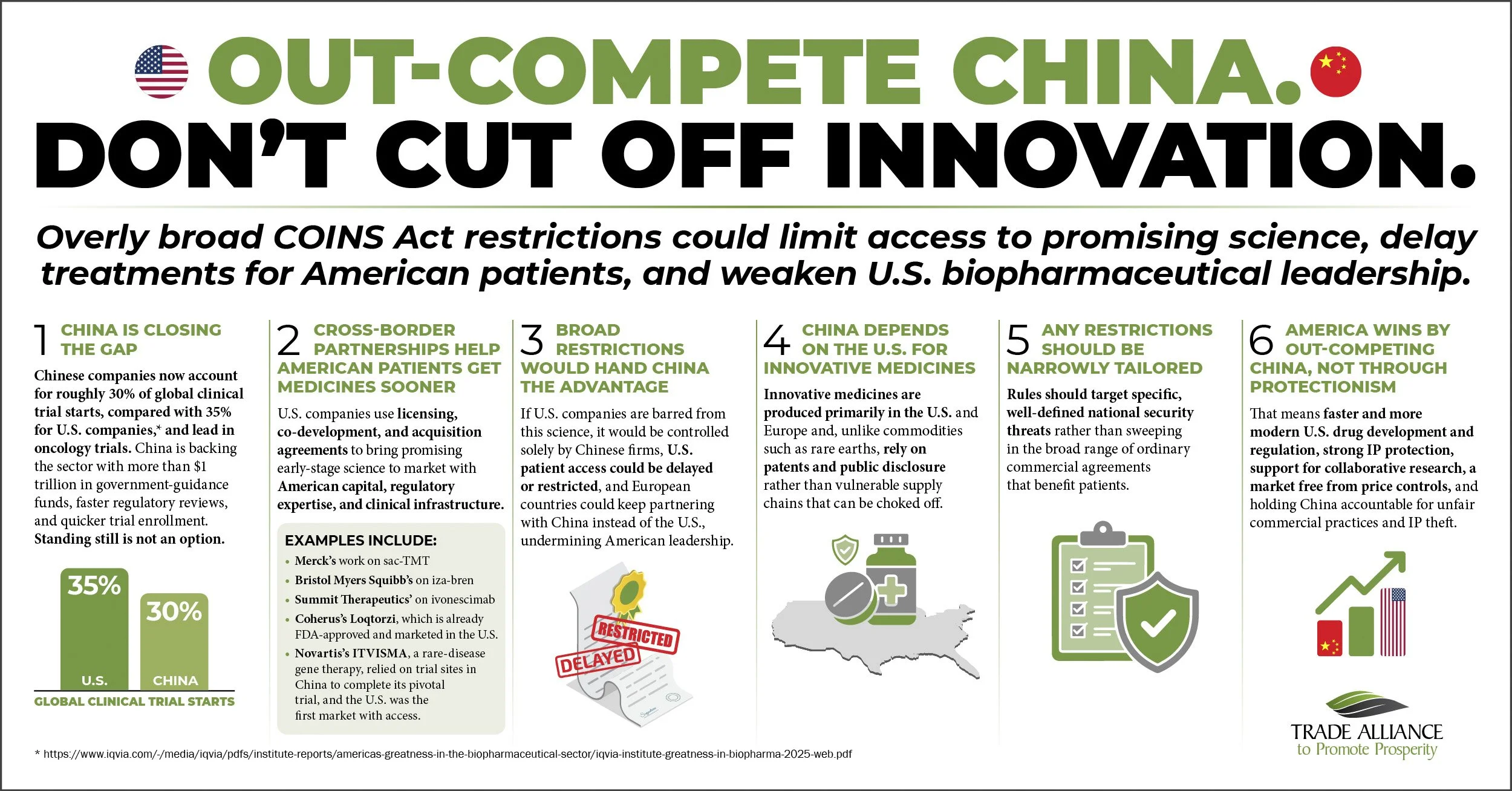
Treasury’s October 22 proposal would cover certain investments involving biotechnology, including activities related to pharmaceutical development. If the final rule draws those boundaries too broadly, it could deter U.S. companies from pursuing licenses, co-development agreements, and acquisitions that bring promising therapies into American development pipelines. A company weighing an early-stage partnership may walk away if it cannot determine whether a license paired with an equity investment would trigger a prohibition. Congress should ask Treasury to give companies clear answers before they commit capital.
Patients have a stake in where Treasury draws that line. Coherus BioSciences partnered with a Chinese biotechnology company to bring Loqtorzi to the United States. In 2023, the Food and Drug Administration approved the medicine for certain adults with nasopharyngeal carcinoma. That example shows what American companies can do when they have access to promising discoveries and can apply their own clinical, regulatory, and commercial expertise.
Broad U.S. restrictions are unlikely to slow China’s pharmaceutical ambitions. They could instead give European and other foreign competitors an advantage in securing rights to promising therapies. American companies would lose development opportunities, and American patients could wait longer for new treatment options.
Before Treasury finalizes the rule, we ask Congress to request that the department:
Tie biotechnology restrictions to clearly defined national security risks. Explain which capabilities and transaction features warrant a prohibition and how the proposed restrictions address those risks.
Clarify how the rule applies to ordinary drug development. Explain when licensing, co-development, and related equity investments fall within the rule, with clear exclusions where those activities present no identified national security risk.
Assess the consequences for U.S. competitiveness and patients. Consult with federal health agencies, American drug developers, and patient groups, and explain how the final rule accounts for effects on clinical development and access to new medicines.
With Treasury’s comment period scheduled to close December 7, we urge you to raise these concerns with the department now and request a briefing before the rule is finalized. Congress has an opportunity to ensure that Treasury protects U.S. national security while keeping American companies in a position to develop the next generation of medicines.