TAPP Urges Congress to Examine Misaligned Incentives in 340B Drug Pricing Program
The Trade Alliance to Promote Prosperity today urged the U.S. House Energy and Commerce Committee to urge Congress to examine misaligned incentives in the 340B drug pricing program as part of the committee’s hearing on “Lowering Health Care Costs for All Americans: An Examination of the U.S. Provider Landscape.”
The federal 340B drug pricing program was created to help vulnerable patients access affordable care. However, a growing body of research suggests that misaligned incentives within the program may be contributing to higher health care costs while failing to reach many underserved communities.
One major concern is the role 340B plays in accelerating provider consolidation. Nearly 36 percent of Medicare Part B therapy sales occurred at 340B hospitals in 2021 — an increase of almost 17 percentage points since 2012. The program’s financial structure encourages hospitals to acquire physician practices, often shifting patients from lower-cost community settings into higher-priced hospital outpatient departments. This site-of-care shift can significantly increase costs: employer-sponsored insurance payments for infused oncology drugs are nearly twice as high when administered in hospital outpatient facilities compared to physician offices for the same treatment. Research has also found that hospital consolidation generally leads to higher prices without improvements in quality or mortality outcomes.
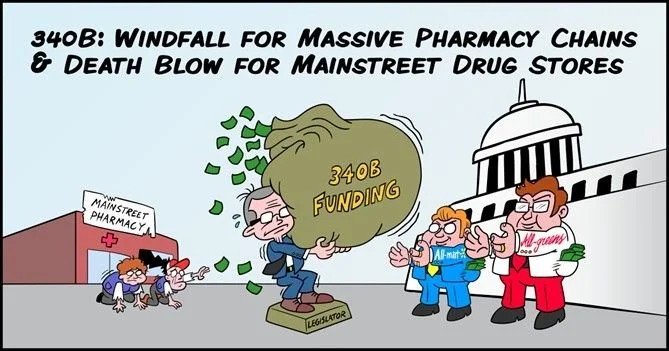
340B has incentivized consolidation and vertical integration of pharmacies, as well, which has led to the closure of many independent pharmacies and the appearance of pharmacy “deserts” across America, especially in rural areas.
At the same time, an AHRQ-funded study found that financial gains for 340B hospitals were not associated with clear increases in care provision or improved outcomes for low-income patients. Expansion of contract pharmacies and child sites has frequently occurred in higher-income and less diverse neighborhoods rather than more urban, medically underserved areas.
Questions also remain about whether 340B disproportionately benefits hospitals that are not true safety-net providers. A small share of hospitals captures the majority of program profits while providing relatively limited charity care. Meanwhile, many nonprofit hospitals receive substantial tax advantages yet spend less on community benefits than the value of those subsidies.
These trends are the impetus for TAPP urging the House Energy and Commerce Committee to consider reforms to better align incentives, improve accountability, and ensure that the 340B program fulfills its intended mission of supporting vulnerable patients while controlling overall health care costs.